

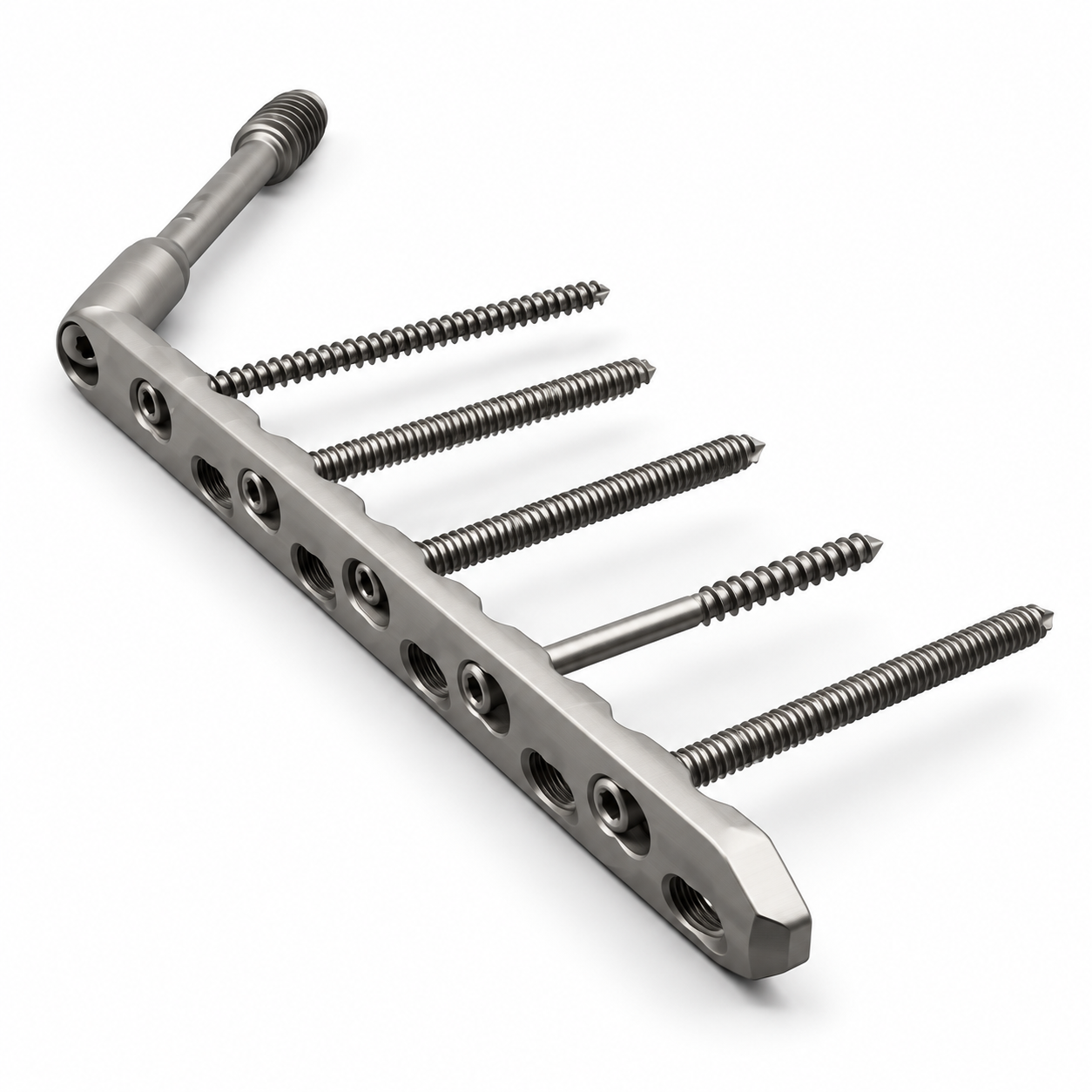


The Orthopedic Locking Bone Plate with Screws is a specialized surgical implant system intended to support internal fracture fixation, bone alignment, and mechanical stabilization during orthopedic procedures. Combining a multi-hole fixation plate with several threaded bone screws, this implant assembly provides a structural framework for stabilizing selected bone fractures.
Internal fixation is an important technique in orthopedic trauma surgery. It involves using implants such as bone plates, screws, and other fixation devices to maintain the position of fractured bone fragments following surgical reduction.
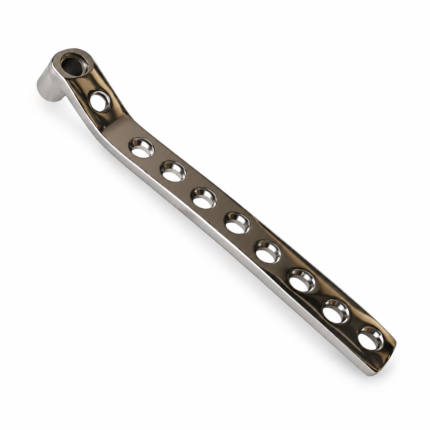
The pictured orthopedic fixation system features a long metallic plate with multiple circular screw openings. Several threaded screws extend from the plate at different positions, demonstrating the multi-point fixation arrangement associated with plate-and-screw constructs.
A raised, angled section at one end gives the implant a distinctive configuration that may be intended for specialized anatomical fixation.
The system is designed for professional use by qualified orthopedic surgeons, with the precise clinical application determined by the manufacturer’s validated specifications.
Key Features of the Orthopedic Locking Bone Plate System
1. Multi-Hole Fixation Plate
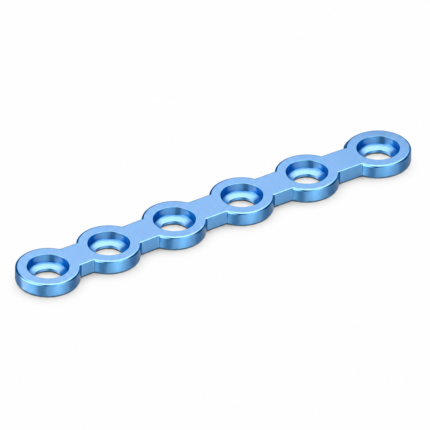
The implant features an elongated plate with several fixation openings distributed along its body. These openings provide multiple potential attachment positions for compatible orthopedic screws.
2. Threaded Bone Screws
The illustrated assembly includes long metallic screws with external threads intended to engage bone tissue. Screw length, diameter, thread pitch, and head design must be compatible with the plate and intended anatomical application.
3. Angled Proximal Structure
One end of the implant incorporates a raised, angled component. This structural feature may provide specialized fixation geometry for particular orthopedic procedures.
4. Multiple Screw Placement Options
The plate configuration allows several screw positions to be incorporated into a fixation construct. Screw placement should be planned according to fracture geometry, bone quality, and approved surgical technique.
5. Metallic Implant Construction
The plate and screws feature a silver-gray metallic appearance commonly associated with orthopedic implant materials. The exact alloy composition requires manufacturer confirmation.
6. Recessed Fixation Openings
The plate incorporates circular openings with visible recessed profiles. Some openings appear to have specialized internal geometry that may be designed for specific screw-head interfaces.
7. Precision-Shaped Plate Profile
The elongated body features smooth external surfaces, defined edges, and a shaped terminal section intended to facilitate appropriate implant positioning.
Orthopedic Applications
The Orthopedic Bone Plate with Screws is intended for internal fixation applications requiring a mechanically stable plate-and-screw construct.
Depending on the implant’s verified design, dimensions, and approved indications, comparable systems may be used in:
-
Internal fixation of selected bone fractures.
-
Stabilization of bone fragments following surgical reduction.
-
Fracture fixation requiring multiple screw attachment points.
-
Maintenance of anatomical alignment during bone healing.
-
Selected orthopedic trauma procedures.
-
Certain corrective osteotomy procedures.
-
Specialized bone reconstruction and stabilization.
The image does not establish the specific anatomical location for which this implant was designed. Its suitability for femoral, tibial, humeral, or other skeletal fixation must be confirmed through manufacturer documentation.
Plate-and-Screw Fixation Technology
Plate-and-screw fixation systems are designed to provide mechanical stabilization by securing a metallic plate to the surface of a bone.
The plate spans the intended fixation area, while screws anchor the plate to the underlying bone.
In conventional plating, stability may depend partly on the compression of the plate against the bone surface.
In validated locking plate systems, compatible locking screw heads engage the threaded plate holes to form a fixed-angle construct.
This type of locking mechanism may be useful in selected fracture configurations, particularly when fixation stability is challenging because of bone quality or fracture complexity.
However, the visible hole and screw arrangement alone does not establish that the pictured product is a locking plate. The locking mechanism must be confirmed through the manufacturer’s technical specifications.
Screw Design and Fixation Stability
The assembly includes multiple long screws with clearly defined external threads.
Bone screw geometry plays an important role in the mechanical performance of orthopedic fixation systems.
Important screw characteristics include thread depth, pitch, core diameter, screw length, head geometry, and material properties.
Appropriate screw selection depends on the anatomical location, bone structure, and intended fixation technique.
The screws shown in the image vary in their visible threaded lengths and shaft configurations, suggesting different screw designs or placement arrangements.
The surgeon must select suitable fixation components according to the implant system’s instructions for use.
Mechanical Support During Bone Healing
The primary purpose of a bone plate and screw construct is to maintain the position of fractured bone segments while healing occurs.
Following fracture reduction, the fixation system is intended to resist selected forces that could otherwise cause displacement or loss of alignment.
The mechanical performance of the implant depends on several factors, including:
-
Fracture configuration and anatomical location.
-
Bone density and structural quality.
-
Plate thickness and material properties.
-
Screw length, diameter, and position.
-
Compatibility between screws and plate holes.
-
Surgical technique and implant positioning.
-
Mechanical loading during rehabilitation.
A stable construct must be selected according to the biological and mechanical requirements of the particular fracture.
Material and Surface Characteristics
The illustrated orthopedic fixation plate and screws have a silver-gray metallic finish.
Common materials used in orthopedic plate-and-screw systems include medical-grade stainless steel and titanium alloys.
These materials are selected for specific implant applications based on mechanical characteristics, corrosion resistance, biocompatibility, and regulatory requirements.
The actual material used in the pictured system cannot be confirmed from visual appearance alone.
Manufacturers should provide material certificates, alloy specifications, and applicable technical documentation.
Technical Specifications
| Specification | Product Details |
|---|---|
| Product Name | Orthopedic Bone Plate with Screws |
| Product Category | Orthopedic Implants |
| Product Type | Internal Fixation Plate-and-Screw System |
| Plate Design | Elongated, multi-hole |
| Proximal Configuration | Raised angled section |
| Screw Type | Threaded orthopedic bone screws |
| Color | Silver-Gray Metallic |
| Material | Manufacturer confirmation required |
| Fixation Method | Plate-and-screw fixation |
| Hole Configuration | Multiple recessed circular openings |
| Locking Mechanism | To be confirmed |
| Surface Finish | Smooth metallic finish |
| Screw Dimensions | As specified by manufacturer |
| Anatomical Indications | Manufacturer-approved applications |
| Sterilization | According to manufacturer instructions |
| Intended Users | Qualified orthopedic surgeons |
Benefits of the Multi-Hole Bone Plate and Screw System
Multiple Fixation Points
The implant provides several screw placement positions along its elongated plate structure.
Fracture Stabilization
When correctly selected and installed, a compatible fixation system can help maintain the anatomical alignment of fractured bone fragments.
Specialized Angled Configuration
The raised section at one end provides a distinctive implant geometry for appropriate specialized applications.
Mechanical Support
The plate-and-screw construct is intended to provide stability against selected mechanical forces during fracture healing.
Compatibility-Based Assembly
The system can combine a plate and designated screws to form an integrated internal fixation construct.
Versatile Fixation Planning
Multiple holes may allow different screw placement patterns, subject to anatomical limitations and the approved surgical technique.
Manufacturing Quality and Precision Engineering
Orthopedic fixation systems require carefully controlled manufacturing processes to achieve consistent quality and mechanical performance.
Important manufacturing considerations include precise machining of plate holes, verification of screw-thread geometry, controlled surface finishing, and dimensional inspection.
Mechanical testing is necessary to establish the intended performance of the plate-and-screw assembly.
Additional quality measures may include material traceability, corrosion testing, biocompatibility evaluation, implant cleanliness verification, and sterilization validation.
Manufacturers must also ensure that compatible components are clearly identified in their technical documentation.
Screw Compatibility and Surgical Considerations
Correct compatibility between the fixation plate and bone screws is essential.
The screw head must interface appropriately with the designated plate hole, and the screw dimensions must be suitable for the intended bone anatomy.
Using an incompatible screw may compromise the fixation construct or damage the implant connection.
The surgical technique should specify appropriate screw positioning, insertion methods, and any relevant tightening requirements.
Only manufacturer-approved combinations should be used in clinical procedures.
Why Choose the Orthopedic Bone Plate with Screws?
The Orthopedic Bone Plate with Screws offers a specialized fixation configuration combining an elongated multi-hole plate, several threaded screws, and an angled terminal structure.
Its design provides multiple potential attachment points for selected orthopedic fixation applications.
For orthopedic implant distributors, medical equipment suppliers, and surgical procurement departments, this type of plate-and-screw system may represent an addition to a specialized fracture fixation product range after confirmation of its specifications, clinical indications, and regulatory authorization




Reviews
There are no reviews yet.