

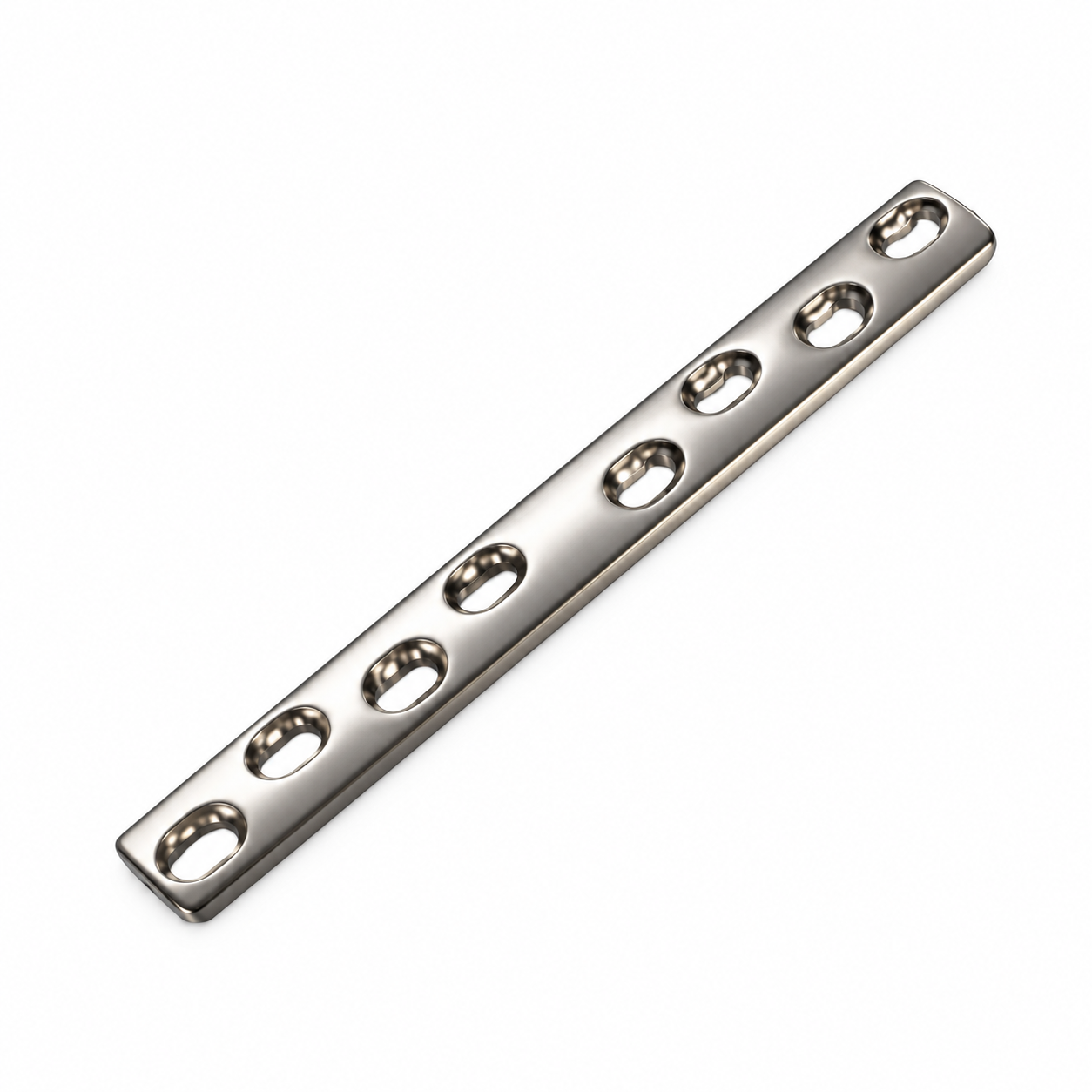

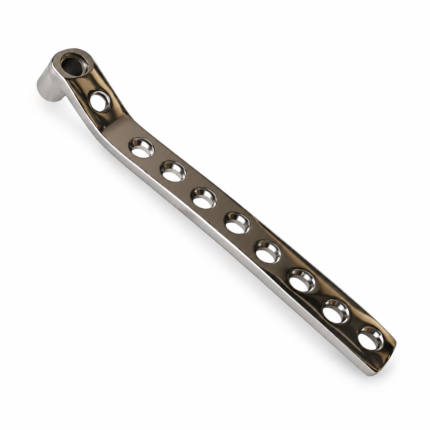
The 8-Hole Stainless Steel Dynamic Compression Bone Plate is an orthopedic implant designed to provide mechanical stabilization during internal fracture fixation procedures. Featuring a straight, elongated structure with eight equally spaced screw openings, this plate offers a practical fixation configuration for supporting bone alignment following fracture reduction.
Dynamic compression plates are widely recognized components of conventional orthopedic plating systems. Their specially designed screw holes can allow controlled axial compression across a fracture when appropriate screws are inserted eccentrically according to the validated surgical technique.
The plate features a silver metallic appearance, smooth surface contours, and rounded edges. Its straight design provides a uniform fixation structure intended for use with compatible bone screws.
The pictured product resembles a conventional dynamic compression plate, although its precise hole geometry, material grade, and compression capability require confirmation from the manufacturer’s technical documentation.
Key Features of the 8-Hole Orthopedic Compression Plate
1. Eight-Hole Fixation Configuration
The plate incorporates eight elongated screw openings arranged along its longitudinal axis. These openings provide multiple potential screw placement positions to establish a stable plate-and-bone construct.
2. Straight Orthopedic Plate Design
Its long, narrow structure offers a straightforward fixation profile for selected orthopedic applications. The straight configuration may be appropriate where a linear plate is indicated by the implant’s specifications.
3. Dynamic Compression Hole Geometry
The visible elongated openings resemble compression-type screw holes. In a genuine DCP system, specially machined hole geometry works with compatible screw heads to produce controlled axial compression when screws are inserted using the correct technique.
4. Smooth Metallic Surface
The plate features a polished silver-colored exterior with smooth transitions around its edges and fixation holes.
5. Rounded Plate Corners
The ends and corners are slightly rounded, providing a refined profile that may facilitate implant positioning and handling during surgery.
6. Multiple Screw Placement Options
The eight-hole configuration allows surgeons to plan screw distribution based on fracture geometry, bone quality, and the approved plating technique.
Orthopedic Applications
Straight dynamic compression plates are used in orthopedic trauma procedures when a suitable plate-and-screw fixation system is indicated.
Depending on the plate’s dimensions, approved indications, and mechanical characteristics, potential applications include:
-
Internal fixation of selected long-bone fractures.
-
Stabilization of fracture fragments following surgical reduction.
-
Compression plating in appropriate fracture patterns.
-
Maintenance of anatomical alignment during bone healing.
-
Fixation of selected osteotomy sites.
-
Fracture reconstruction requiring conventional plate fixation.
-
Selected orthopedic trauma procedures.
The specific anatomical applications of this product must be verified through its manufacturer documentation.
Dynamic Compression Plate Design and Working Principle
A dynamic compression plate is designed to support fracture fixation through a controlled interaction between the screw head and the specially shaped plate hole.
In a validated DCP system, eccentric screw insertion can cause the screw head to slide along the inclined portion of the hole as the screw is tightened. This movement can generate axial compression across a fracture when the plating construct and surgical conditions are appropriate.
Compression fixation may provide absolute stability in suitable fracture configurations, supporting primary bone healing when accurate anatomical reduction and sufficient interfragmentary compression are achieved.
However, not every elongated plate hole provides dynamic compression. The compression function must be verified for the specific plate design.
Structural Stability and Fracture Alignment
Orthopedic fracture treatment often requires maintaining anatomical reduction while limiting unwanted movement between bone fragments.
An appropriately selected bone plate provides mechanical support to maintain fragment positioning and resist selected loads.
The stability of the fixation construct depends on multiple factors, including plate thickness, material properties, screw configuration, screw-bone purchase, fracture geometry, and surgical technique.
The 8-hole configuration provides multiple potential anchoring positions along the plate, although the number and placement of screws must be determined according to clinical requirements.
Material and Surface Finish
The product features a silver metallic appearance commonly associated with stainless steel orthopedic implants.
Medical-grade stainless steel is used in certain orthopedic fixation systems because appropriately manufactured implant alloys can provide the strength, corrosion resistance, and mechanical properties required for their intended applications.
Nevertheless, the image cannot independently confirm stainless steel composition or a specific material grade.
The manufacturer should provide documented material specifications and appropriate compliance records.
Technical Specifications
| Specification | Details |
|---|---|
| Product Name | 8-Hole Straight Orthopedic Compression Plate |
| Product Category | Orthopedic Implants |
| Product Type | Bone Fixation Plate |
| Plate Configuration | Straight |
| Number of Holes | 8 |
| Hole Design | Elongated, recessed openings |
| Color | Silver |
| Material | Stainless steel, if manufacturer-confirmed |
| Surface Finish | Smooth metallic finish |
| Fixation Method | Compatible orthopedic bone screws |
| Compression Mechanism | Subject to verification of DCP geometry |
| Available Lengths | As per manufacturer |
| Screw Compatibility | Manufacturer-specified |
| Application | Internal fracture fixation |
| Sterilization | According to manufacturer instructions |
| Intended Users | Qualified orthopedic surgeons |
Benefits of an 8-Hole Dynamic Compression Bone Plate
Controlled Fracture Compression
When the plate has validated dynamic compression geometry, appropriate screw insertion may generate axial compression across suitable fracture patterns.
Multiple Fixation Points
Eight screw holes provide several potential fixation positions for planning stable plate-and-screw constructs.
Straight Structural Configuration
The elongated design offers a practical fixation structure where straight plating is anatomically and mechanically appropriate.
Support for Bone Alignment
Correctly applied internal fixation systems can help maintain fracture reduction and alignment throughout healing.
Smooth Surface Profile
The polished metallic appearance and rounded edges provide a refined surgical implant design.
Conventional Orthopedic Plating Compatibility
When the plate belongs to a compatible DCP system, it may be used with designated conventional cortical or cancellous screws according to the manufacturer’s specifications.
Quality and Manufacturing Standards
Orthopedic compression plates require controlled manufacturing processes to achieve consistent mechanical performance and dimensional accuracy.
Important quality considerations include:
-
Verified implant-grade material composition.
-
Precision machining of compression holes.
-
Dimensional tolerance inspection.
-
Mechanical strength and fatigue evaluation.
-
Corrosion resistance testing.
-
Surface finishing and cleanliness control.
-
Screw and instrument compatibility testing.
-
Material traceability and manufacturing documentation.
-
Packaging and sterilization validation where applicable.
Manufacturers should document compliance with relevant medical device regulations and applicable implant standards.
Why Choose the 8-Hole Straight Orthopedic Compression Plate?
The 8-Hole Straight Orthopedic Compression Plate provides a conventional-looking fixation design featuring multiple elongated screw openings and a streamlined metallic profile.
Its configuration offers potential versatility for orthopedic plating procedures where a straight compression plate is indicated.
The combination of eight fixation positions, a narrow rectangular body, and smooth exterior contours makes it suitable for inclusion in an orthopedic implant product catalog, provided its material composition, compression functionality, and approved applications have been verified.
For medical equipment suppliers, orthopedic distributors, and surgical implant procurement teams, this type of product represents an important category within conventional bone fixation systems.



Reviews
There are no reviews yet.